Kindergarten and First Grade Blog


About Me

My photo
Little Wonders is a wonderful learning center located right here in Missouri City. This is where talent, imagination and professional skills are being dedicated to the teaching of our young children. We understand that children learn differently. Through observation and listening, we encourage each individual's unique learning styles; while focusing on their physical, educational and emotional needs. All of our teachers are professionally qualified with combined expertise in education, speech & hearing therapy, bilingual education and English as a Second Language. With a low student-teacher ratio, we provide your child with the attention they need. Little Wonders Learning Center is located at the corner of Lexington Blvd. and Dulles Ave. In this center, you will find a number of warm, loving teachers committed to putting children first. This isn't your ordinary day care facility.

Friday, September 16, 2011

Field Research at Castle Park

Our previous post on our study of birds,


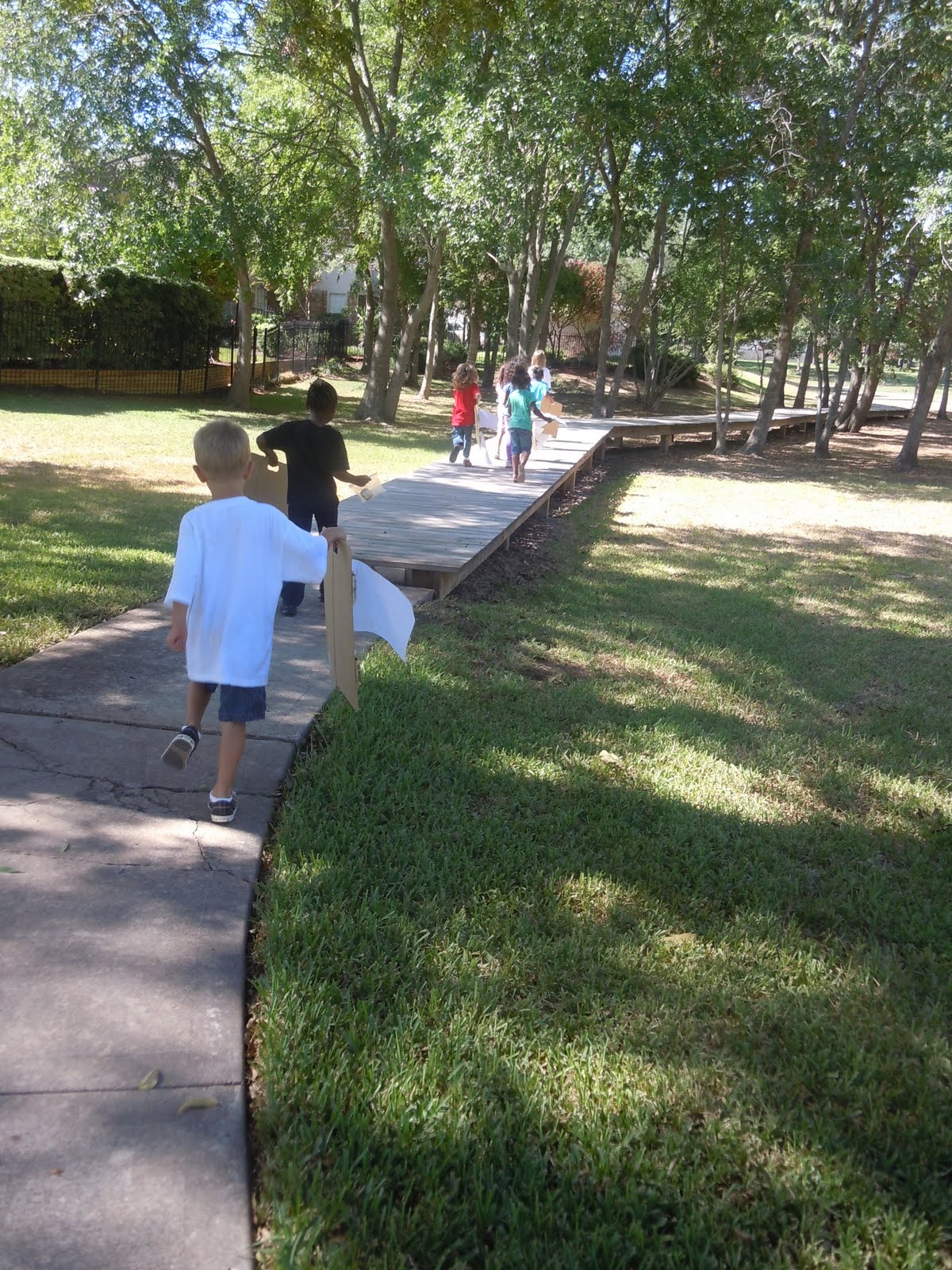
shows how this project lead us to visiting Castle Park.  Annika suggested we go there to see "duck nests in hollow trees".  This was a perfect opportunity for us to do some "field research", and collect raw data in a natural setting. It  also helped to reveal the habits and habitats of various organisms present in their natural surroundings.

One of our course objectives is to identify the needs of living organisms and the difference between living and non-living organisms.  To help the children make these observations, they each were given a clipboard with two worksheets. 
1.)  The first was a Non-living Organism Chart.  The children were to observe and write a list of 8 non-living organisms we found in the park
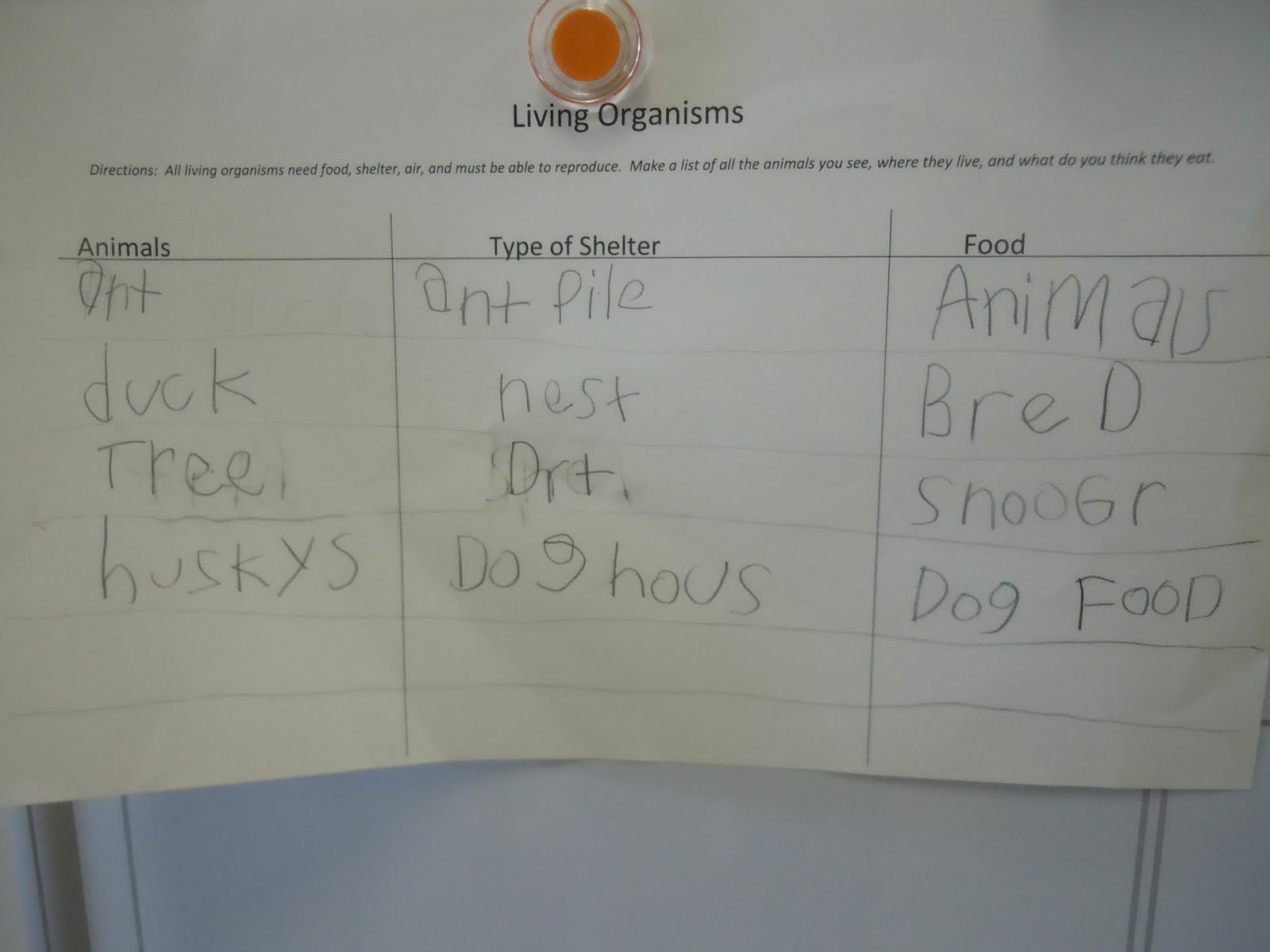
2.)  The second was a chart to record any Live Organisms we found, and what their food and shelter was.

The conversations, observations, and writing started right away!!!!!


After spending some time noting our observations, we were off to find the pond with the ducks that Annika had been talking about...........
                                   But to our surprise, the entire pond had dried up!!!!!!!!!!!!!
The children were so amazed, it took some time for them to comprehend what had happened.  This lead to a wonderful conversation on EVAPORATION! ;0)  They got to see it right before their very eyes!  It was such an experience for the children to see a place that not too long ago was filled with water and ducks, completely dried up with "cracked ground"!

But we took advantage and started exploring........

We went to the famous hollow tree that housed the duck nests....
We climbed in, looked around and found several "clues" of what animals used to be there.  We found lots of feathers!  Hmmmm.....  Could it be the ducks Annika saw before. 


We took time to sit down and make connections from our findings and our observations. 

 - Why did the ducks leave?
-  Why did they choose the hollow tree as a nesting site?
- Why did the pond dry up?
-  What can bring water back into the pond?
We took out our charts to note our observations at the dried pond.......


When we searched around what used to be the pond, we found empty oyster shells!!!!!  Who knew Sugar Land had oysters??????
- Why were they empty shells?
-Who do you think ate the oyster?
After completing our notes, we just had to take one more run at the "cracked ground"!  This was too much fun!
However, the fun ended quickly when our teacher and friend sunk deep in the mud!!!!!! ;0)  No worries though, we pulled everyone out, washed off when we got back to the school, and learned a very valuable lesson......................................

Just because the ground looks dried and cracked, doesn't mean there is not deep, soggy mud hiding under it!!!!! ;0)

samples of our work........


stay tuned as this project continues .............

Perfecting Our Math Skills

For the past month the students have been working hard to perfect their math skills in addition and subtraction! Some of us are moving on to double digits, borrowing in subtraction and even carrying over in addition!
The children have been perfecting ANSWERING addition and subtraction problems, but how about MAKING the problems????

We put them to the test to see how well they would do when they created their own math problems for each other.  Each student used different materials to help create a math problems..

                                                                   Using Popsicle sticks...
               Each child wrote each math problem on their own, and picked what numbers they wanted to use..
                                          They counted out each item to help make sure they were correct!
                                                     Using the spinner to pick a number! ;-)
  Some of the students love drawing pictures, so we used their pictures to help create math problems.
 Mark drew out ten suns and than cut each one out to decide what math problems he would like to set up for himself.
                                         " I'm going to use the counter since I love it so much! "

                              Tirza said she wanted 17 hearts.  She made more than 17, so we number the page and she chose her favorite 17 hearts to use in her math problems. 


Mark made 5 orange suns, and 5 blue suns.  He created the math problem "5 blue suns and 5 orange suns is 10 suns" ~ 5 + 5 = 10

Here are some of our first math worksheets created by the students ;0)

                                                                          By: Shirmar
                                                                   By: Annika
                                                                   Jaylin's Math sheet
                                                                           By: Kyle


Wednesday, September 7, 2011

Birds

Over the summer, the summer school children helped the PreK children work on bird nests as part of a bird project.  As the project grew,  more children from other classes became interested in birds.  Annika took the bird nest she helped work on into the Kinder and First Grade classroom during the first week of school.  This continued an in-depth study of concepts, ideas, and an interest in birds with the Kinder and First Grade children.

 
As we began to introduce the skills the K-1 class was to master, we incorporated the study of birds.  The children used the computer lab and books to research different types of birds.  Each child chose a bird to study.  
For reading and spelling, the children were given word lists that described birds.  We used words that helped the children categorize birds.  Birds are birds because they have - Feathers, Wings, Hollow Bones, Beaks and they lay Hard Shelled Eggs.
The children used the word list over several days and did different activities to help practice handwriting.  We gave each child a paper with a picture of his/her bird and the children labeled the bird according to the word list.  This helped the children sound out the words to practice our reading skills.


Two days a week we visit the art studio, and on this particular day the children created art pieces to represent his/her bird.  The children studied the birds with the art director to observe shapes and details in the birds.  Some of the children chose water color, while others chose to make their birds out of clay.


We began to study where birds lay their eggs.  This allowed us to begin to research nests in different habitats, how birds molt and "camouflage" if they do not migrate in the winter, and to study their life cycle.  We worked on a program in the computer lab to help the children learn the life cycle of the bird.

One of the children brought in a humming bird nest, and when the children saw how small it was, the question came up of how big the eggs were.  Annika researched their question on line and found the measurements of the humming bird egg.  She used clay to create 2 eggs (since we learned that humming birds only lay 1 to 2 eggs) and put them in the humming bird nest.  That lead to the children wanting to know what was the biggest egg a bird could lay.  They wrote out their question and typed it in the computer.  We found out it was an Ostrich egg!  Annika used paper mache to create a model of the egg after they recorded the measurements.

We have continued to research more sizes of eggs and we recreated a duck egg, and found out that an Elephant bird used to be alive and it laid the biggest egg.  It is now extinct, which is why the Ostrich is now the biggest.
                                        
We have our "egg display" in a display box in the hallway!

This was the perfect opportunity to introduce graphing.  We used our measurements and created a graph to show the difference in sizes.


We will use our graph to compare our data, and create math problems to understand what information the graph can help us learn.

Annika suggested that we take a field trip to Castle Park, where she knows some ducks lay their eggs in a hollow tree.  We will use this trip to learn about habitats and make real life observations about the environment.  We will take samples to bring back and observe in our microscope, chart our observations, and introduce the concept of living vs. non living organisms.

Our visit to the park and the details on the progress of our project will be posted soon!!!!


Wednesday, August 31, 2011

Who am I? Exploring Self Portraits

Who am I?
We are beginning to dive deep into what this question is truly asking.  We have started a project with our art director, Marjon Aucoin, to help our Kinder and First Grade students answer this question.  We will look carefully at self-portraits by Vincent van Gogh, Paul Gauguin, and other various artists.  Throughout the year, the children will make a variety of self-portraits, write poetry, give a speech about themselves to their classmates, and a letter about themselves—all to be placed in their self-portrait portfolio.

Who am I? is not a simple question. In fact, as we have started this project, we are seeing that it leads to many more questions.  Here are some that have come up:

  • What are the things that make me happy?
  • What are the things that make me sad?
  • What is a happy color? (For Nohea - pink, for Mark - blue)
  • What is a sad color? (Shirmar - green)
  • What color is an angry color? (Jennifer - red)
  • What are the things that I like?

It is exciting to see the children exploring their sense of self through diverse forms, and we are seeing how they are begining to form ideas about their identity.

Below is a sneak peak at the first step in creating our self portrait portfolio:

Photos were taken so that the children would have their pictures to study as we worked.......


When they entered the art studio, the photos and materials were ready.....

The children engaged in a discussion about self portraits and began to explore their photos by talking about shapes, colors, and facial characteristics.  We talked about what colors could represent emotions we feel.

The children began to explore creating their first self portrait!


In the end, beautiful pieces stood before us!!!!!
Nohea chose to use many colors because she said they made her happy.

Alex focused on her beautiful eyes, and she needed a yellow smile because yellow meant she was happy.

After spending several minutes thinking about what she really liked, Annika said that her favorite group of animals were birds, so she made a peacock feather and a mocking bird feather in her portrait.  She also loves Yellow Stone Park, so she drew a buffalo as well!


For a viewing of all of our portraits, please visit our room to see them on display.  Stay tuned for progress on our Self Portrait Portfolios ;0)